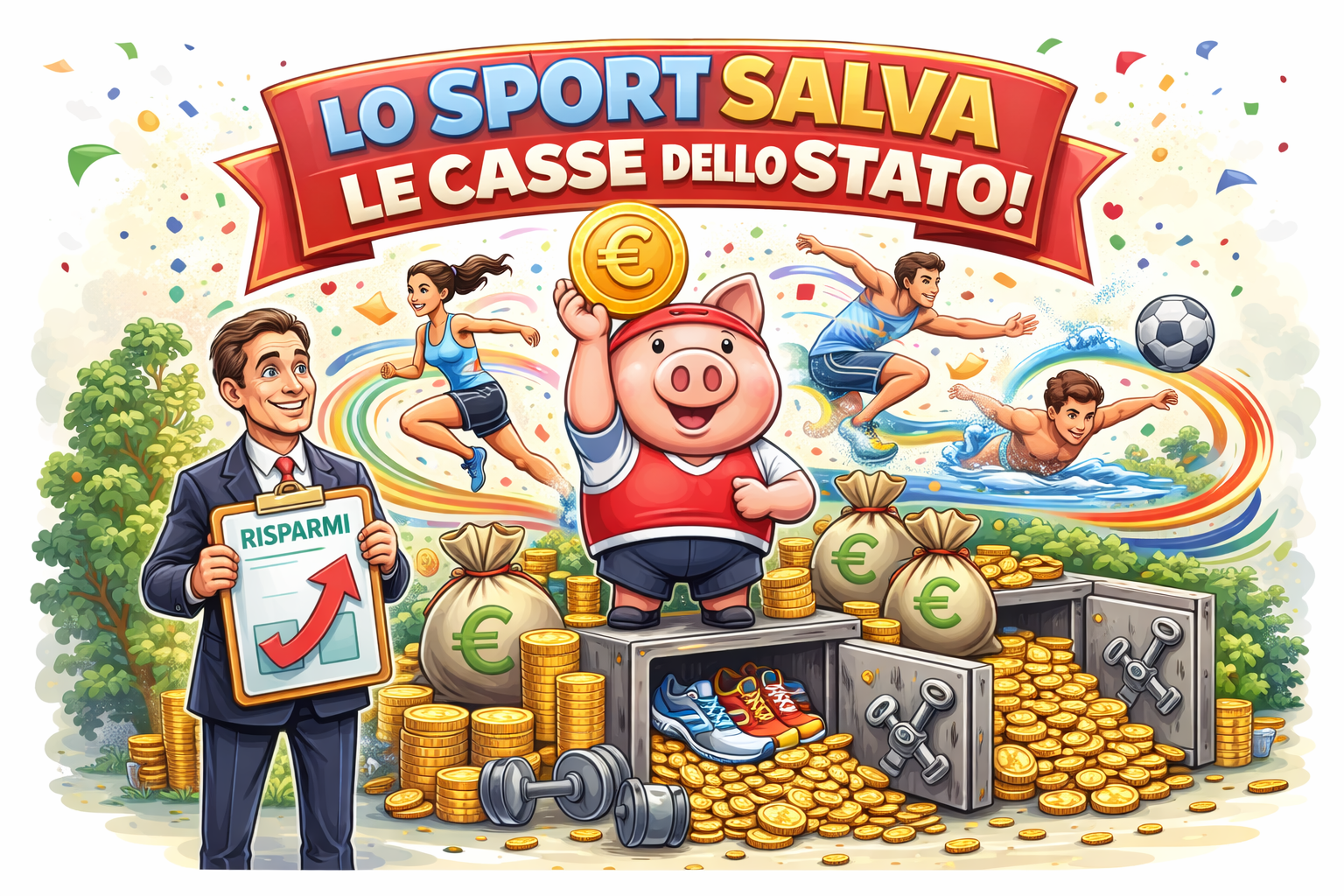
When it comes to sports, our thoughts almost always turn to free time, to personal well-being, to physical fitness. It is rarely linked to public accounts, to pensions or the sustainability of the State. Yet it is precisely here that a new reflection is opening up.

The president of the INPS, Gabriele Fava, in a recent speech in the magazine Formiche, he said it very clearly.
LPhysical activity must permanently enter the culture of welfare. Not as a slogan, but as a concrete lever of sustainability.
The invisible cost of a sedentary lifestyle
There is a fact to start from: not doing sport costs money. And it costs a lot. According to analysis of World Health Organization and Organization for Economic Co-operation and Development, physical inactivity is destined to generate billions of euros in healthcare spending in the coming decades. It's not difficult to understand why.
A sedentary population is more exposed to chronic diseases such as type diabetes 2 or cardiovascular diseases. These are pathologies that not only affect the quality of life, but they require long treatment, expensive and continuous. In Italy it means growing pressure on the National Health Service. And this is only the first part of the problem.
From health to work: the ripple effect
The real leap in quality in reasoning comes when we leave healthcare and look at work. A healthy person works harder, better and longer. He gets sick less, he is absent less, maintains its autonomy for longer.
Unlike, those who develop chronic pathologies tend to leave the job market earlier or reduce their productive capacity. This has a direct effect on public finances. On the one hand, the contributions paid are reduced, on the other hand, the benefits to be paid increase.
Because sport is really of interest to INPS
When it comes to social security, we immediately think about pensions. But the system is much broader: includes disability, income supports, welfare measures. In this context, the health of the population becomes a fundamental economic variable.
If people feel better they work longer, they go on disability less frequently and log in later (o meno) to forms of early retirement. This means, in simple terms, more income and less expenditure for the system.
This is precisely the meaning of the President's speech Fava.
Sport is not just an individual matter, but a factor that affects the overall sustainability of welfare.
A paradigm shift: from passive welfare to active welfare
The real innovation lies in the way of interpreting welfare. For years the model was predominantly "passive": the State intervenes when the problem manifests itself, paying cure, pensions or subsidies. The idea that emerges today is different. Investing in sport means acting first, reducing problems at the root. In other words, spend today to save tomorrow.
In this perspective, doing physical activity takes on a role similar to that of health prevention or vaccinations. It is no longer just a private choice, but a public policy component.
The limit not to be ignored
At this point it is important to avoid easy enthusiasm. Saying that sport "saves the state coffers" is effective, but it risks being misleading if taken literally. The economic benefits exist, but they are gradual, distributed over time and depend on many factors.
Then there is another aspect that is often underestimated: from the North to the South of the country, not everyone has the same opportunities to do sport. Income differences, territory, age and access to facilities make the picture very unequal. Without targeted public policies, the risk is that the topic remains confined to individual responsibility, without producing systemic effects.
The real challenge for Italy
If you really want to transform sport into a tool for economic sustainability, a leap in quality is needed. It means making physical activity accessible, widespread and integrated with school, work and healthcare. Means, essentially, treat it as a real social infrastructure.
The idea that sport can contribute to maintaining public finances is not a provocation, but a strategic direction. It will not solve the problems of Italian public spending on its own, nor those of social security.
But it can have an impact, silently and progressively, on one of the most important factors: the health of the population. And in a country that is aging rapidly, this could make a much bigger difference than we are used to thinking.
Alex Gaetani
Insights:
On the importance of physical activity