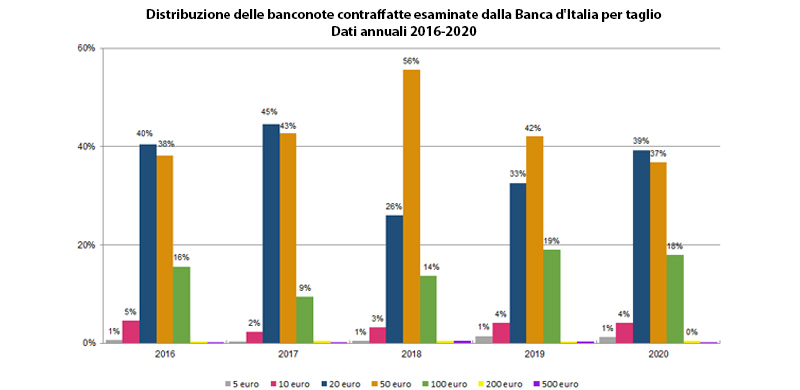
In 2020 The Bank of Italy has recognized false 65.229 Euro banknotes withdrawn from circulation (-27,7 percent compared to 2019). This is the lowest data recorded after the 2002, year in which the euro began to circulate as a physical currency.
The most falsified cuts continue to be the ones from € 20 and € 50, which represent over three quarters of the total.
When there are doubts about the authenticity of a banknote in one's possession, you must not try to spend it - you would commit a criminal offense – But it is necessary to have it examined by the branches of the banks or post offices that send it to the Bank of Italy which provides citizens with a service for verifying suspicious banknotes of falsehoods.
If the banknote is authentic, The citizen is refunded with the value of the banknote preferably with a bank transfer or, alternatively, with a comparison of the Bank of Italy issued in its name. If it is false, will not receive any refund.
The Ministry of Finance publishes a Statistical relationship on the falsification of the euro, in which historical and territorial series analyzes on the phenomenon.
The most effective means of protecting itself from falsifications and to avoid the economic loss that derives from the acceptance of a false banknote is to increase one's knowledge of the safety elements of banknotes: On the website of the European Central Bank there is a useful support to do it.
But also on the portal of the committee for the programming and coordination of financial education activities, insurance and social security there is one Practical guide to recognize false money.
Watch out for false banknotes!
Alex Gaetani