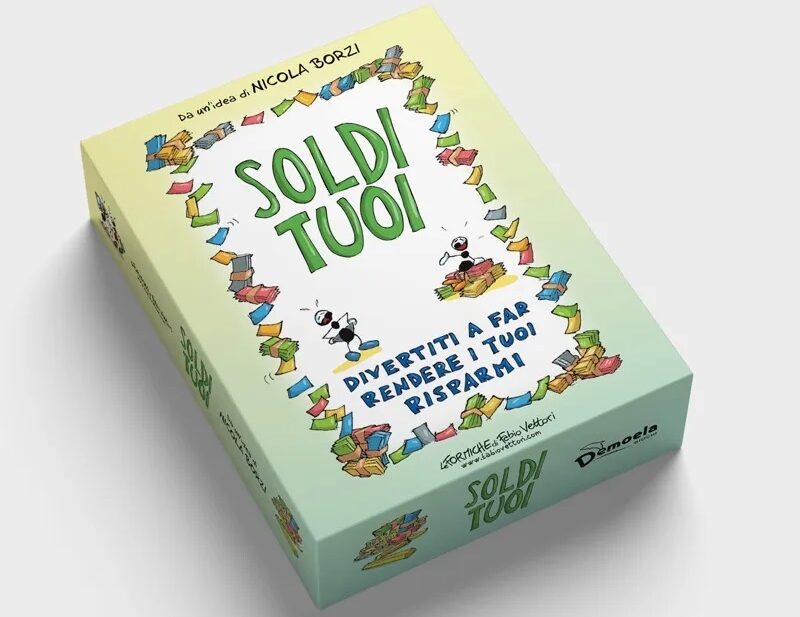
Financial education can also come through gaming. Con Your money, the economic journalist Nicola Borzi proposes an original way to bring adults and children closer to the topics of savings and investments. In this interview he tells how the idea was born and what objectives the project has.
Nicola, because today talking about money in the family is still so difficult?
It all stems from the fact that control over money is power. But a family cannot be based on power: it must be based on love, on mutual sharing and respect. However, too often in families, decisions about money and saving are delegated only to those who work (or worse to those who arrogate them). This means that in an unequal country with gender discrimination, as unfortunately Italy is, women who often do not have a job are not able to have their say and end up being subjected to other people's decisions. E’ one of the forms of subjugation, the legacy of a chauvinist culture. This is still often seen in some immigrant families. E’ not just serious behavior, but also harmful to families: if the man leaves or dies, Wives and children often find themselves having to manage complicated situations that they don't know and haven't known anything about before.
What is the most common mistake that Italian savers make when managing their money?
The available assets are distributed extremely unequally: according to the Bank of Italy the 20% poorer than Italians (almost 12 millions of people), excluding the house, has on average just 3 thousand euros in cash each, while the 10% richer (just under 6 millions of people) instead he has at his disposal 1,07 a million per head. The errors therefore vary from case to case, from family to family. But three are almost constant:
- the first and most widespread is to invest all or almost all in the brick (that's not true at all “he doesn't cheat”: it certainly betrays and will betray more and more with the decline in the population which will cause house prices to collapse);
- the second is not to look at how much it costs to manage your savings entrusted to banks, agent networks, Insurance (every Italian family spends on average 2.400 euros per year of banking and financial commissions, they could save half of it, 100 Euro pulls);
- finally, do not insure against the risks of loss of income due to illness, disability, death and against “happy risk” of living so long that you run out of money.
What is it “Your Money Game” and what message it wants to bring to families?
After 26 years in the Sun 24 Hours, 15 of which dedicated to writing about savings, after 8 years at Fatto Quotidiano, after about twenty books, booklets and pamphlets dedicated to saving, I understood that unfortunately people are very ashamed to ask for information, even the basic ones. In my opinion, the limit of those who want to spread financial education is that they do not face this barrier. I thought it was a game that entertains and makes you laugh and joke, it might work better than an education that seems to come from above. So I imagined Your money, a card game come on 14 years and up to have fun and effortlessly learn the basics of finance.
Tra social, apps and promises of easy earnings, how can a person learn to recognize financial risks?
Scammers are always coming up with new tricks, diverse, technological, very dangerous. But their messages are always based on a few factors: they promise higher returns than controlled forms of investment, they usually promise them stable, they link hypothetical past returns to future opportunities, they boast of skills and CVs, they exhibit personal wealth and status. The first rule is: never believe, always look for verification, check and never, May, never trust statements or documents produced by these gentlemen or by those in cahoots with them. Always check online, ask the police, Financial Police first and foremost, whether these people have a true story or if they made it up, if it is authorized to propose investments and collect savings. Higher returns are always linked to higher risks, there are no stable and ever-increasing future returns, Past returns guarantee nothing for the future. Never give money in cash, never leave these people the possibility of operating on their bank accounts or their securities, Never believe what you see on the internet, never be tempted and fall for strategies “relaunch”. Stay away from anything you don't understand well and never trust word of mouth from relatives, friends and acquaintances: they are often unaware victims too.
What advice would you give to a family to build greater financial awareness?
Starting again from the wisdom of our elders: all eggs are never kept in one basket; better a solid selection of slow but sure tools than the mirage of quick and easy wealth (see cryptocurrencies); Never invest in something you don't really understand; consider that an additional management cost or commission which may seem like a small thing, also “only” 1% more per year, with compound interest over twenty years it becomes a blow to your savings. Never blindly trust anyone who sells investment products because they are almost always in conflict of interest. Finally, soprattutto, always check, always ask questions, always ask for simple explanations, always ask for all documents, at least try to read them. If you don't understand them it's not a drama, “no one is born learned”, there is nothing to be ashamed of: there are things that not even the so-called experts understand. To obtain information and clarifications, you should never contact the same person who proposes the investment, but to savers' associations and independent financial advisors registered in the professional register.
From the answers of Nicola Borzi the desire to make financial education more accessible and engaging emerges. Your money represents an innovative attempt to bring these themes to the general public through a simple and immediate tool such as the board game.
Alex Gaetani
Find out here Your money and enjoy making your savings profitable