Mission
"As investors we must be aware of the consequences that the use of our money and can lead to reaffirm the importance of values and ethics in the management of money" (From the Manifesto of the Bank's strategic policy Ethics)
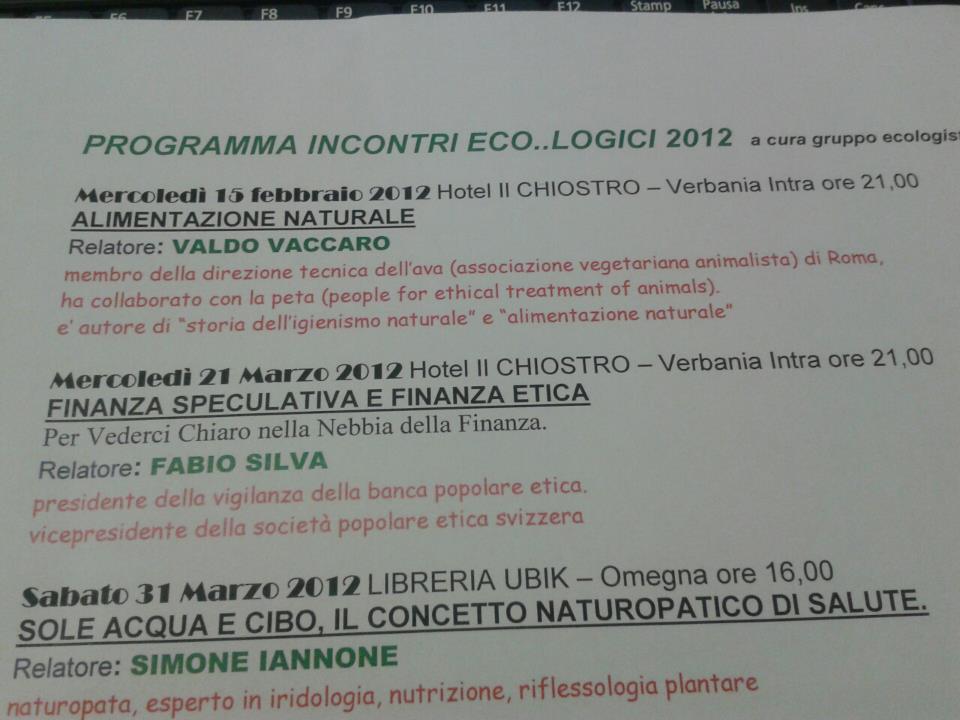
As part of events organized by environmental group, was held on 21 March in Verbania, the meeting "Speculative Finance and Ethical Finance - To see this clearly in the fog of finance", with Fabio Silva (Chairman of the Supervisory National Bank Vice-President of Society Ethics and Popular Ethics Switzerland).
Silva began by reading a part of the statute of the Savings Bank of the Provinces of Lombardy (Cariplo) founded in 1823, explaining how the savings bank was born to play simultaneously lending and charity, with the mission to support the economy of Lombardy and the social and cultural growth of the community (ideal, values, people).
Values that, according to the rapporteur, the banking system in general has lost his way.
He then continued with a discussion on the current world crisis we are experiencing, now from 2007.
For Silva, four were the causes of the crisis:
-
30 years of neo-liberalism which lasted almost dramatically: we got to have financial transactions equal to 3.000 billion dollars a day, when world trade is 10.000 billion a year.
-
the ongoing process of debt, both institutional and individual, always linked to the push towards a stronger unnecessary consumerism, borrowing the concept of the child "I have everything" (in economics textbooks and school training was talk of primary goods and secondary goods).
-
the extreme financialization of real (Cirio cases, Parmalat etc..) where the entrepreneur wants to spend the money with the "fatigue" of the production of tangible goods, the speed of easy money through financial transactions – Note specifically that financial transactions are passed to represent the 109% of the total wealth of the world 1980 al 316% 2005 (yet here he lamented the failure to introduce the Tobin Tax - a "tiny" tax on financial transactions).
-
international imbalances in rich countries (U.S., EU and Japan) and poor: in the current financial system to give comfort and privileges to residents in the rich countries need to have against the huge pockets of poverty.
He then listed the tools of the global financial devastation, with focus on Italy:
Recycling: Italy is the fourth "laundry" of the world (Here the speaker explained how the term was born Laundry since Al Capone: In fact it was the owner of laundries, activities in which it was precisely "cleaned" dirty money coming from the criminal activities of his organization).
Corruption: several studies related to almost all countries of the world, shows that in terms of corruption “perceived” Italy is closer to emerging countries than to those OECD. In fact, the great Italian numbers related to this phenomenon, which is a major obstacle to economic development of countries, place Italy in 69 th place in the world, to 4 th place in Europe.
Finance black: derivatives and other tricks of the financial market.
In closing, and before you answer the many questions posed by the public, He told the story of Account Number, of which he was a founding partner in 1999 and then proposed several possibilities to realize a business ethics, although few have the means available.
In fact, the Account Number, which is a bank to all effects, has only sixteen branches throughout the Italian territory and a network of financial planners to whom you can ask for money to invest, thanks to Ethics Sgr, the company's asset management. The latter will carry the art of the Statute which reads .5: "Sgr .... Ethics is intended to represent the values of ethical finance markets and raise public awareness of socially responsible investment and corporate social responsibility. The Company's activity is characterized by great transparency "
Alex Gaetani
To learn more about these issues I recommend the following books:
Week of global mobilization
for a Financial Transaction Tax by the 15 al 22 May 2012
http://www.valori.it/moduli/maggio/005_Blogger.pdf